

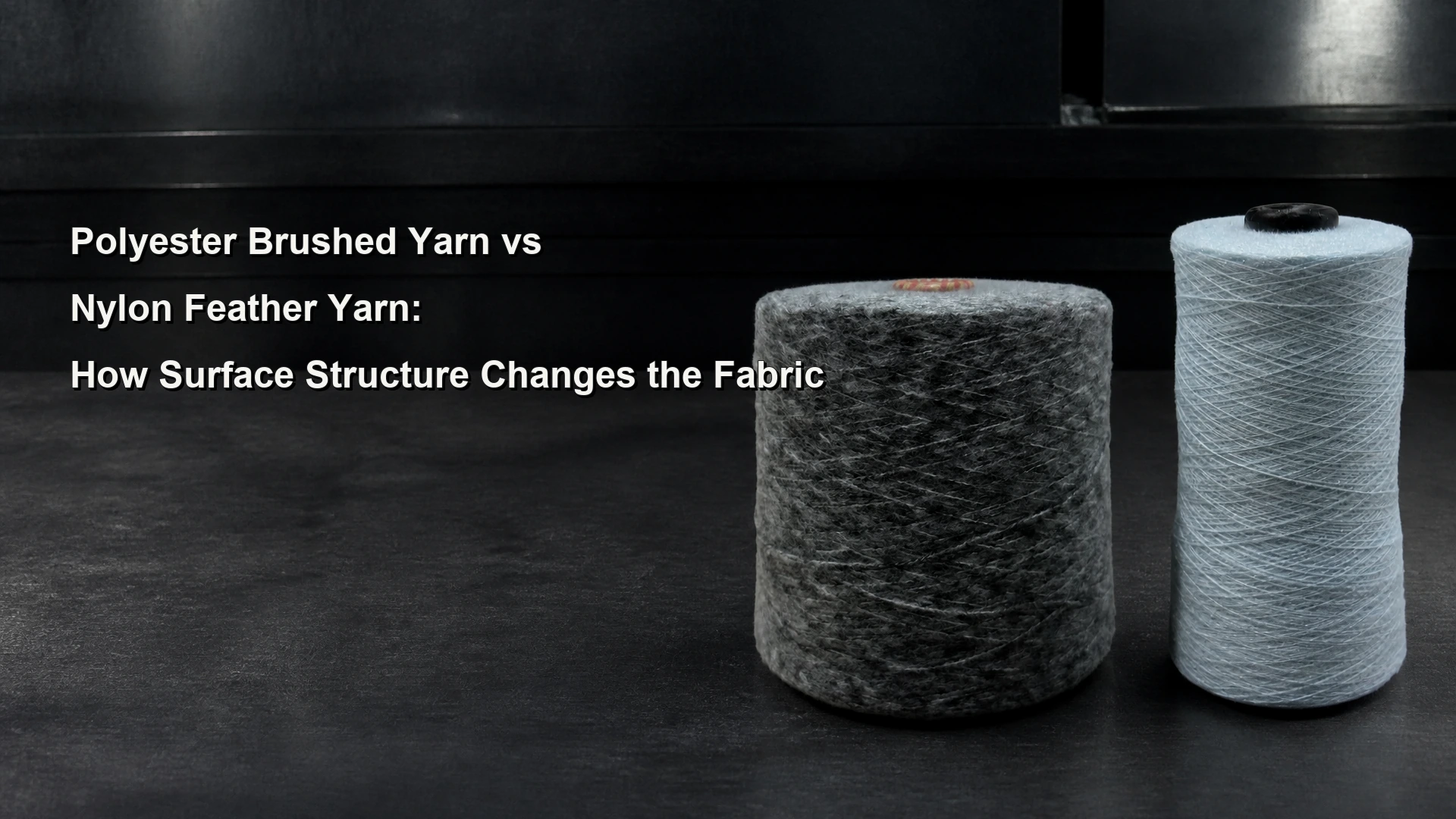
Compare polyester brushed yarn and nylon 0.5 cm feather yarn by surface architecture, fabric coverage, loop visibility, directionality, and controlled sample approval.
Polyester Brushed Yarn vs Nylon Feather Yarn: How Surface Structure Changes the Fabric
A yarn may look “fuzzy” in a product photo and still produce a fabric unlike another fuzzy yarn. That is the practical issue behind a Polyester Brushed Yarn vs Nylon Feather Yarn comparison. The two materials reviewed here are SALUD’s 100% polyester brushed yarn, specified as 9NM/1, and its 100% nylon 0.5 cm feather yarn, specified as 70D/48F/2. Both belong to the fancy-yarn category, but their visible surface architectures are different.
This comparison is not a single-variable experiment. Composition changes from polyester to nylon, while count and construction also change. Any difference in a finished swatch may therefore reflect material, yarn construction, knitting conditions, finishing, or the interaction among them—not surface structure alone. Buyers should use the observations below to frame a controlled sampling plan, not to predict an untested production result.
1. Identify the Two Yarn Architectures

Start with what can be inspected directly. The 100% polyester brushed yarn is a 9NM/1 fancy yarn with a short, continuous, relatively even brushed layer around the strand. In the reference sample, that layer reads as a compact grey haze. Individual projections do not dominate the outline; the surface appears connected along the yarn length.
The 100% nylon 0.5 cm feather yarn is a 70D/48F/2 fancy yarn with a visible core and short fibers arranged around it. Those fibers have a recognizable direction. The “0.5 cm” in this article refers only to this exact feather specification. It should not be used as a general statement about products with other pile lengths.
That distinction matters before a machine is threaded. A brushed surface visually softens the strand as one continuous layer; a feather yarn presents the core plus projecting short fibers. Record both the base specification and visible architecture. Descriptions such as “fluffy grey yarn” are too broad to prevent substitution.
Use photos only as identification support. Ask for composition, count or construction, surface type, color reference, and a physical sample. The yarn product directory helps teams keep fancy-yarn families separate.
2. Compare Surface Coverage and Loop Visibility

In a knitted fabric, surface coverage is the relationship between the yarn’s projecting material and the loop structure beneath it. It is not simply “more hair equals more coverage.” Gauge, stitch, tension, yarn feed, color, lighting, relaxation, and finishing all affect whether the eye reads a smooth field or distinct loops.
A short, continuous brushed layer can soften loop edges across the fabric while still allowing parts of the knitted construction to remain visible. Because the surface layer is compact and distributed along the strand, the transition between adjacent loops may appear less sharply outlined. This should be described as a visual tendency to check in a swatch, not as a guaranteed opacity result.
The 0.5 cm feather construction places directional short fibers around a core. In a fabric, the viewer may read both the underlying route of the yarn and the lay of those projecting fibers. Depending on stitch formation and finishing, the surface can show areas where the direction of the short fibers is more apparent than the loop geometry. Yet the core and loops do not cease to exist; they may become easier or harder to see as the sample is turned or handled.
For a fair comparison, knit equal-size swatches in the same target color and evaluate them at the intended distance. Color contrast can exaggerate structural visibility. Note where loop columns remain readable and whether the appearance stays even across center and edges.
Do not approve from a macro image alone. Review a full swatch photo, a raking-light detail, and the physical sample.
3. Check Directionality and Fabric Appearance

Directionality becomes visible when the surface changes with viewing angle or a controlled light sweep. The brushed sample’s short, continuous layer may read comparatively even because many fine projections contribute to the same compact surface. The feather sample’s core-plus-fiber structure can make the lay of the 0.5 cm projections easier to recognize.
One fabric is not always uniform while the other is always streaked. Stitch direction, take-down, panel orientation, joining, finishing, and handling can strengthen or reduce the effect. Include panel orientation in the review.
Place both swatches under the same light, photograph from one position, and rotate each 180 degrees. Make one pass with the same clean, soft brush and observe any change in surface tone or highlight path. Record neutral findings such as “highlight strengthens from one direction.” Avoid vague approvals such as “good fluff.”
SALUD already has a separate guide on how to choose feather-yarn pile length. The present comparison does not repeat that selection exercise. It keeps the feather side fixed at 0.5 cm and examines how that core-and-directional-fiber architecture differs visually from a short, continuous brushed surface.
4. Control the Knitting Trial Variables

The fastest way to create a misleading comparison is to change several machine settings and then attribute the result to yarn surface. A useful trial controls what can be controlled and documents what cannot.
Begin with same-color yarns so contrast does not dominate. Confirm 100% polyester, 9NM/1 brushed yarn against 100% nylon, 70D/48F/2, 0.5 cm feather yarn. These counts are not equivalent measures and do not make the yarns interchangeable.
Run each yarn on an independent documented path. Keep the package stable and the tube opening clear; the strand should unwind from the outer layer through its own eye, tension system, feeder, and needle zone. Photograph the setup before testing.
Then define the knitting variables: machine, gauge, needle selection, stitch, programmed dimensions, feed arrangement, take-down, operating speed, and recorded tension setting. Use the same nominal setup when technically practical, but do not force an unstable condition merely to claim that every number was identical. If a yarn requires a changed setting to knit reliably, document the change and stop calling the result a strict side-by-side control.
Make more than one swatch. The first checks whether the yarn can be processed under the planned setup. A repeated swatch checks whether the surface appearance can be reproduced. Mark knitting direction and face side immediately. After knitting, apply the same relaxation time and the same approved finishing route to both samples. If finishing differs, preserve unprocessed control pieces so the team can separate machine effects from finishing effects.
The objective is not to declare a universal winner. It is to establish which combination of yarn, machine conditions, stitch, and finishing creates the surface required for this particular fabric.
5. Inspect the Finished Swatches Under Real Handling

A flat photograph cannot show everything. After equal relaxation and agreed finishing, inspect swatches flat, bent, lightly handled, and from multiple directions. Keep handling gentle and consistent; this is observation, not an abrasion test.
Compare center, edges, and corners. Note where loop visibility or coverage changes. Rotate each swatch 180 degrees under fixed light and record shifts in highlight, shade, or surface direction.
Next, lift and bend each swatch separately. Bending can open the loop structure and reveal how much of the visual field comes from the yarn surface versus the fabric construction. On the brushed sample, check whether the short continuous layer remains visually connected over the curve and where loops become clearer. On the feather sample, check how the 0.5 cm fibers lie at the bend and whether the core becomes more visible. These are inspection questions, not predetermined outcomes.
Handle both with clean hands and the same sequence. Do not compare one freshly brushed sample with another that has been compressed in transit. If shipping or storage has changed the surface, photograph the received condition before any recovery step, then record exactly how the sample was allowed to relax.
Approval should include an actual retained swatch, not only images. Physical samples allow production and quality teams to compare surface coverage, loop visibility, directionality, and overall appearance under their own lighting. If the result remains sensitive to orientation or finishing, add that condition to the approval rather than leaving it in an email thread.
6. Write a Procurement Approval That Prevents Substitution

The approval document should describe the product that was tested and attach the fabric result that was accepted. “Polyester fuzzy yarn” and “nylon fluffy yarn” are not adequate purchase descriptions. They omit the construction that created the approved appearance.
For the brushed option, state 100% polyester; 9NM/1; Fancy Yarn/Brushed Yarn. Add the approved color reference and describe the surface as a short, continuous, even brushed layer, using the retained yarn sample as the visual standard. For the feather option, state 100% nylon; 70D/48F/2; Fancy Yarn/Feather Yarn; 0.5 cm. Describe the visible core-and-directional-short-fiber architecture without broadening the approval to other pile lengths.
Capture machine and gauge, stitch, tension, feed route, panel direction, relaxation, and finishing. Attach dated setup and swatch photos, and give each retained physical swatch an order-linked sample ID.
Include five approval fields:
- Composition: exact fiber content for the submitted yarn.
- Yarn construction: count/construction, fancy-yarn family, surface architecture, and 0.5 cm specification where applicable.
- Gauge & tension: actual trial setup and any approved adjustment.
- Finishing: process applied to the approved swatch and its orientation during review.
- Approved swatch: signed or otherwise controlled physical reference with date and sample ID.
Add a non-substitution statement: no change to composition, count/construction, surface architecture, color standard, or approved finishing without a new machine trial and written approval. This is important because a visually similar cone can contain a different yarn architecture, and a different architecture can alter coverage, loop visibility, and directionality.
Finally, request confirmation against the retained standard before bulk release. If the specification, trial setup, or physical sample is unclear, contact SALUD Style with the exact sample ID and the intended machine conditions. The most reliable purchase decision is not based on a single product photo. It is based on a controlled, same-color knitting trial and a written approval that keeps composition, construction, surface, process, and finished swatch connected.
