

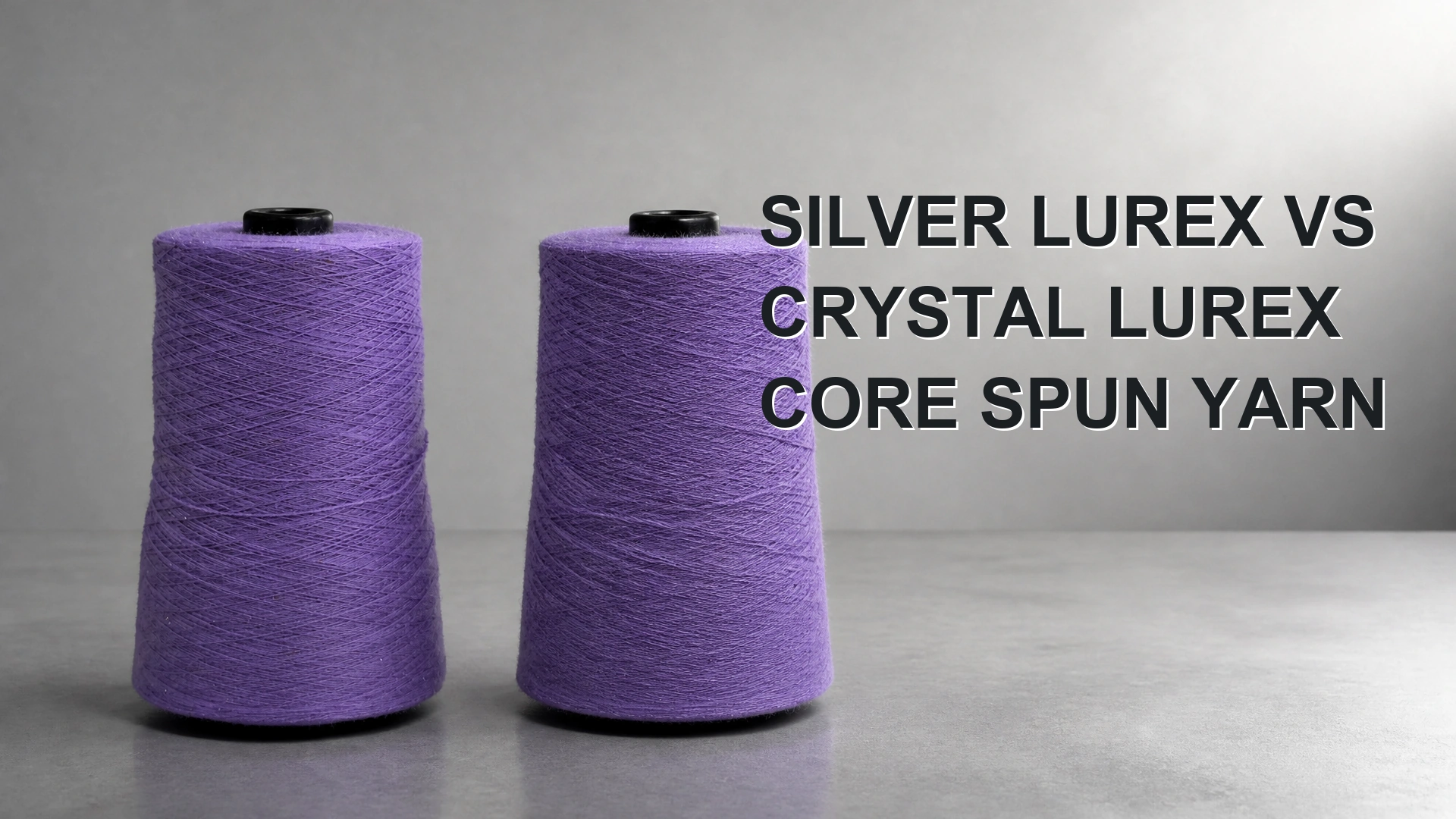
Compare Silver Lurex vs Crystal Lurex with a controlled sample-and-swatch review for clearer metallic-effect approval.
Silver Lurex vs Crystal Lurex Core Spun Yarn: Choosing the Right Metallic Effect
For buyers comparing Silver Lurex vs Crystal Lurex core spun yarn, the practical question is not which name sounds more decorative. It is how the two options look when the comparison is controlled well enough to support a purchase decision. SALUD lists a 47% Viscose 26% PBT 22% Nylon 5% Lurex Silver Core Spun Yarn and a 47% Viscose 26% PBT 22% Nylon 5% Lurex Crystal Core Spun Yarn. Both are specified as 28s/2. Because those basic figures are shared, the comparison should move quickly from the product name to physical samples and matched fabric trials. This is an approval exercise rather than a contest based on assumptions. “Silver” does not by itself prove a particular level of brightness, and “Crystal” does not guarantee a particular pattern of sparkle. Appearance can change with color, fabric structure, finishing, illumination, and the viewer’s angle. A useful sourcing process controls those factors, reviews yarn and fabric together, and leaves a traceable record of what was accepted.
Confirm the Shared Specification Before Comparing Appearance
 Begin with what can be confirmed in writing. The Silver Core Spun and Crystal Core Spun options are both listed as 28s/2 and both use the same composition: 47% viscose, 26% PBT, 22% nylon, and 5% Lurex. These facts create a common starting point, but they do not remove the need for visual checking. Buyers can review the wider core spun yarn category for context, while keeping the two named products separate in the approval file. Prepare two sample cards with a consistent amount of yarn and a clear identity for each option. The cards should come from the actual samples being evaluated, not from photographs collected at different times. Record the supplier’s product name, the stated 28s/2 count, the shared composition, the sample date, and an internal reference code in the purchasing file. These records prevent a later swatch from being separated from the yarn that produced it. Do not add unsupported conclusions to the specification sheet. The shared count and composition do not establish a visual ranking. They also do not explain how a metallic detail will appear in a particular construction. At this stage, the goal is simply to verify that both candidates are being compared on the intended specification and that the physical samples are correctly identified. If the initial samples are different base colors, request matched colors before judging the metallic presentation. A color shift can change perceived contrast and can easily be mistaken for a difference between Silver and Crystal. The same principle applies to photographs: images from different cameras or backgrounds may be useful for identification, but they are not a substitute for a side-by-side physical review.
Compare the Yarn Under One Controlled Light Setup
 Place the two yarn samples on the same neutral inspection surface. Keep their length, spacing, and orientation as similar as practical. Use one stable light position rather than moving each sample to a different desk or window. The observer should view them from the same distance and begin from the same angle. This simple arrangement reduces several variables that can make two samples look more different than they are. Examine the yarn first without trying to force a verdict. Look for the way small reflections appear along the sample as the viewing angle changes. A reflection may read as a short line in one position and as a small point in another. That observation is descriptive; it is not a performance claim. Neither product name should be used as a shortcut for what the eye must confirm on the delivered sample. Use the same base color for both candidates. Keep the background neutral and avoid mixed light sources. If daylight and an overhead lamp fall on the table at once, the comparison becomes difficult to repeat. A better practice is to select a controlled condition, note it briefly, and repeat the review later using the same setup. The purpose is not to create laboratory photometry but to make the visual decision consistent enough for a purchasing team. Take reference photographs only after the physical comparison is arranged correctly. Include both samples in the same frame and avoid automatic image adjustments that treat one side differently. The photograph should support the approval record, while the retained yarn samples remain the primary physical evidence.
Knit Matched Swatches Instead of Judging Yarn Alone
 Yarn presentation on a card does not show the complete fabric result. The next step is to knit matched swatches using the same color, the same stitch or fabric structure, and the same swatch dimensions. Keep the setup consistent across the two trials. A difference in structure can alter how much yarn is visible at the surface and how reflected details are distributed across the field. The swatches should be clearly separated and identified in the working record. Do not stack them during the first inspection, because overlap changes the surface plane and the light each sample receives. Lay both flat with a small gap, align their directions, and check that the structure is genuinely matched before discussing the metallic presentation. This stage should focus on what is visible in the actual fabric. Note whether reflective details read more as intermittent lines, isolated points, or another restrained pattern under the chosen condition. Do not translate those observations into a universal claim. A result seen in one matched pair is evidence for that approved trial, not proof that Silver is always brighter, Crystal is always more sparkling, or either option is inherently superior. If the swatches were not made with the same structure, stop and repeat the trial. Similarly, a color difference should be corrected before approval. Buyers can browse SALUD’s broader yarn product range for procurement context, but the final choice between these two named options should rest on the controlled pair being reviewed, not on unrelated product imagery.
Check Viewing Angle and Distance Without Changing Other Variables
 Metallic details respond to the relationship between the surface, the light, and the observer. A flat, straight-on view is therefore only one part of the check. With both matched swatches under the same light, gently change the angle of one swatch, then repeat the same movement with the other. Use a small, repeatable movement rather than bending or folding one sample more than the other. Review at a consistent close distance, then step back to a second agreed distance. The close view helps the team describe individual reflective details. The more distant view shows how those details combine across the swatch. Keep the viewing sequence the same for both candidates. If several people are approving the result, let them use the same position rather than viewing from different sides of the table at once. Record neutral observations. For example, a team can note that a detail becomes visible when the swatch is tilted toward the side light, or that the surface reads differently at the second distance. Avoid words that imply measured intensity unless measurement data actually exists. This article does not establish brightness, wash, or other performance figures, and the product names should not be treated as such data. After the angle check, return both swatches to the same flat position. A final side-by-side view confirms whether the purchasing group is judging the samples under the original condition. If a decision changes dramatically with an angle that matters to the project, that is a reason to document the viewing condition more carefully, not a reason to make a universal claim about the yarn.
Review Each Yarn Together With Its Corresponding Fabric
 For the approval meeting, arrange each yarn sample with the swatch made from it. Keep the Silver route and the Crystal route separate. The physical relationship should be easy to follow: sample to corresponding fabric, without crossed labels or mixed pieces. This step helps prevent a common administrative error in which a preferred fabric is approved but the originating yarn sample is not clearly identified. Compare the yarn-level observation with the fabric-level observation. The purpose is not to demand that they look identical; yarn geometry changes when it becomes a knitted surface. Instead, confirm that the team understands which visible fabric result belongs to which submitted yarn. If a photograph is taken, include both routes in one frame and keep the items in their recorded positions. Ask the purchasing and technical participants to use the same descriptive language. Terms such as “line-like reflection” or “point-like reflection” can be useful when they describe what is seen in that trial, but they should not be turned into guaranteed product attributes without further evidence. The approved decision must remain tied to the exact samples, color, structure, finish, light, and viewing method. If the comparison is inconclusive, request another matched sample set rather than guessing from the words Silver and Crystal. SALUD’s contact page can be used to discuss sample identification and the two listed product options. A clear request should repeat the product name, 28s/2 count, shared composition, desired matched color, and the need for side-by-side evaluation.
Record the Approved Visual Reference and Keep the Physical Set
 The final decision should produce an approval set, not just a meeting note. Retain the Silver sample yarn, its corresponding knitted swatch, the Crystal sample yarn, and its corresponding knitted swatch. Store them with a written approval record that identifies the shared 28s/2 count and the 47% viscose, 26% PBT, 22% nylon, 5% Lurex composition. Include the base color, the matched stitch or structure, the finish used for the comparison, and a brief description of the controlled light and viewing angles. Attach photographs as secondary references, preferably showing both options under the same condition. Keep image editing limited to basic documentation needs and avoid enhancements that change the metallic appearance. Physical samples remain important because screens, cameras, and viewing environments can alter how small reflections are displayed. The written approval should state exactly what was accepted: a specific yarn sample and a specific swatch under a documented comparison condition. It should not say that one named option is always brighter, darker, or more sparkling. The result belongs to the approved sample set. Future submissions can then be checked against that retained reference rather than against memory or a product name. This process gives procurement teams a defensible way to choose between Silver Core Spun and Crystal Core Spun when the count and composition are the same. Control the base color, structure, finishing, light, angle, and distance; compare both the yarn and the matched fabric; then preserve the physical evidence and written approval. The name opens the conversation, but the retained sample-and-swatch set closes the decision.
