

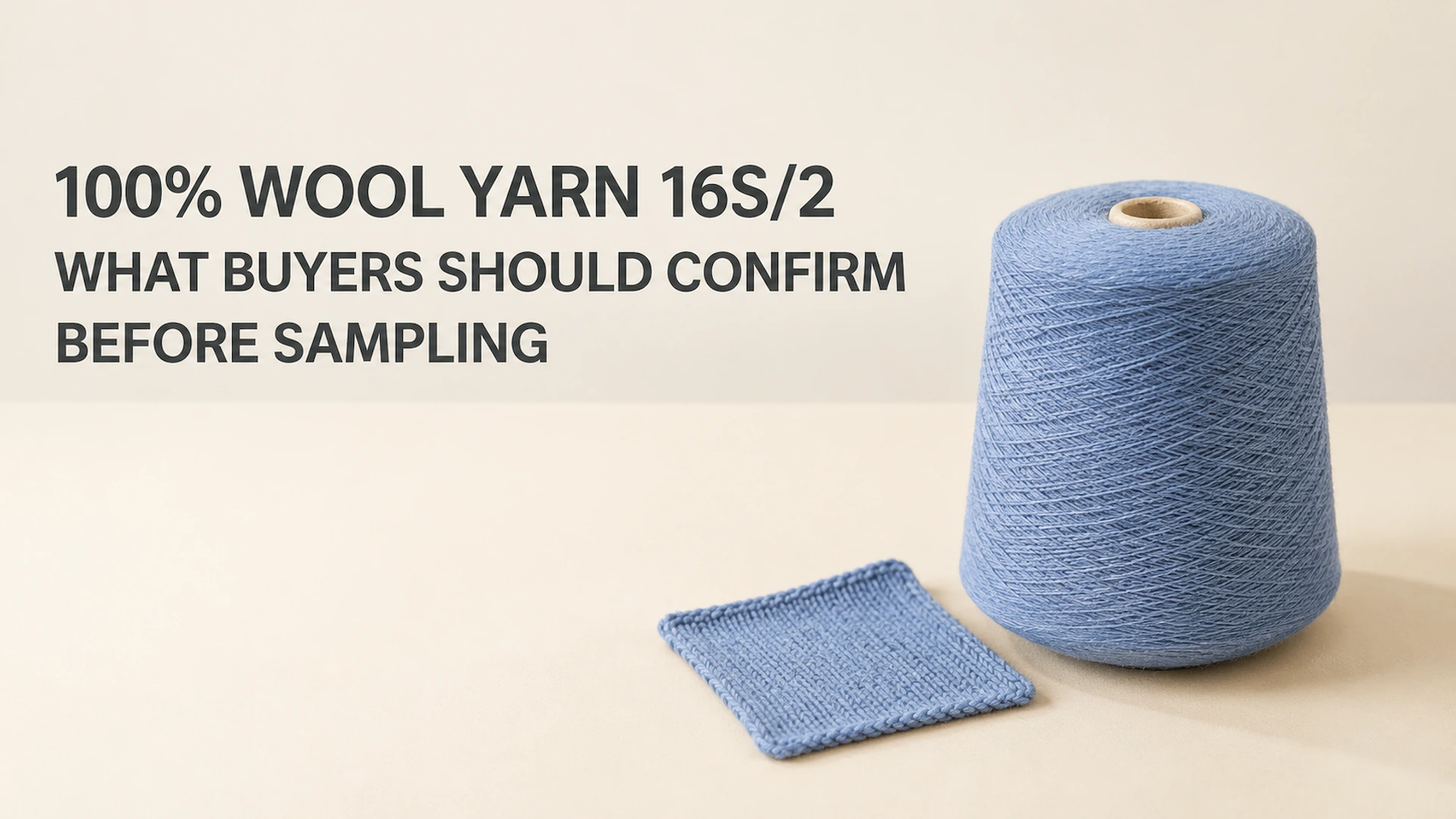
A buyer’s guide to confirming 100% Wool Yarn 16S/2 content, construction, color, swatch, hand, labels, and packing before sampling.
100% Wool Yarn 16S/2: What Buyers Should Confirm Before Sampling
A yarn sample is most useful when buyer and supplier agree on what it is meant to represent. A short description such as “wool yarn, 16S/2, blue” may look complete, yet each part still needs a written reference. If those references are missing, two people can approve different things while believing they approved the same sample.
For this discussion, the confirmed product record is narrow and clear: SALUD product ID wy001 is recorded as 100% Wool Yarn with the specification 16s/2. The public 100% Wool Yarn product page also confirms that the product is publicly listed. These points should not be expanded into claims that are not attached to the record.
The practical goal before sampling is therefore alignment. The buyer should confirm fiber content, count and ply wording, color reference, the form of the swatch, comparative hand language, and the label and packing instructions. The six steps below turn those subjects into a sample request that can be checked by both sides.
Confirm the Fiber Content in Writing

Start the sample request with a direct content line: Fiber content: 100% wool. Keep this line separate from the count, color, and packing notes. A dedicated content field makes the instruction easy to find on the inquiry, sample order, and approval record.
The wording should remain exactly as confirmed. Do not add a wool class or any other material qualifier unless it is supported by a separate written record. “100% wool” answers the composition question; it does not define every attribute of the fiber or finished yarn. Keeping the statement narrow prevents an assumed detail from becoming an unintended requirement.
The broader wool yarn category can help a buyer navigate the site, but a category page should not replace the exact written line for wy001. The sample record remains the controlling reference for this request.
A concise confirmation block can read:
- Product record: wy001
- Fiber content: 100% wool
- Required confirmation: repeat the content on the sample document and relevant label copy
This structure is simple, traceable, and less open to interpretation than relying on a conversation subject line.
Define 16S/2 Without Ambiguity

Write 16S/2 in both the inquiry and the sample order, then add plain-language context: yarn count: 16S; construction: two-ply. The added wording is not a substitute for the notation. It is a cross-check that tells both parties how the buyer is reading the specification.
The “/2” should be treated as the two-ply construction instruction. It should not be read as a statement about wool class, fiber dimensions, machine settings, or any result expected from the yarn. In the same way, “16S” is the count notation in this product record, not a shorthand for unrelated attributes.
If the buying team needs background on count terminology, SALUD’s yarn count guide provides general context. For the present sample, however, the agreed entry should stay focused on the recorded specification rather than importing broad statements from another page.
A practical line for copying is:
Specification: 16S/2 — record 16S as the yarn count and two-ply as the construction. Please reproduce this wording on the sample confirmation.
Before approval, compare the inquiry, sample order, and dispatch note character by character. Capitalization is less important than preserving the number, the separator, and the ply statement without substitution.
Fix the Color Reference Before Sampling

Color requests need a physical or clearly identified reference. A color name by itself is rarely enough because terms such as dusty blue, brick brown, and deep green describe a family of shades rather than one agreed target. Select the reference first, then name it in the sample order.
SALUD can provide a color card and a yarn sample. The buyer should identify which item controls the first sampling round and keep that reference available for comparison. If the target is not selected from the supplied color card, the buyer should provide a Pantone number rather than relying only on an on-screen image or informal color name.
The written instruction can include four short fields:
- Color reference source: supplied color card, supplied yarn sample, or buyer reference
- Reference identification: the exact code or document name
- Target wording: approved shade for sampling
- Comparison item: the physical reference retained by the buyer
Avoid mixing several unranked references. If a physical yarn cutting, a digital image, and a color number differ, the supplier needs to know which one takes priority. One controlling reference and clearly labeled supporting material make the decision easier to reproduce.
When the sample arrives, compare it with the named reference in a consistent viewing situation. Record the decision as accepted for the next step or return a relative correction such as “slightly less blue than this sample.” Do not silently replace the reference midway through the process. If the target changes, issue a new written reference and identify it as the current one.
Request a Knitted Swatch for Hand Evaluation

A cone sample shows the yarn in package form, but hand is easier to discuss when the yarn is also presented as a knitted swatch. SALUD can provide the corresponding fabric sample, so the inquiry should ask whether a swatch can accompany the yarn sample and how it will be identified.
The purpose of the swatch is comparison and communication. It gives the buyer a stable physical item to touch, view, retain, and reference in comments. It should not become the basis for unsupported statements about attributes that were never agreed in the sample record.
Ask the supplier to connect the swatch clearly to the yarn sample. The swatch note should repeat the product record, content, 16S/2 notation, and color reference. This avoids a common administrative problem: a useful fabric piece arrives, but its relationship to a specific cone or document is unclear.
The buyer should also keep the swatch in its received condition while reviewing it. If several colleagues will assess it, circulate the same physical piece where practical and consolidate their comments into one response. Separate impressions from different pieces can introduce unnecessary variation into the discussion.
Bulk production will have a further sample confirmation before proceeding. That later confirmation should be treated as its own documented decision, not assumed from acceptance of the first inquiry sample. The first swatch helps establish language and direction; the later sample confirms the agreed reference for the production step.
For availability and sample coordination, the buyer can consult SALUD’s FAQ and then place the exact requested items in the inquiry.
Describe the Required Hand in Practical Terms

Hand comments work best when they are relative, specific, and tied to a physical reference. Instead of asking for “a better hand,” state what should move and in which direction compared with the submitted yarn sample or swatch.
A simple hand-reference sheet can contain three qualitative fields: surface, fullness, and drape. The buyer fills these fields only after handling the real sample. They are prompts for observations, not preset claims about 100% Wool Yarn 16S/2.
Useful comparative wording includes:
- Surface: “smoother than submitted swatch” or “retain the current visible wool character”
- Fullness: “slightly fuller than submitted swatch” or “keep the present relative fullness”
- Drape: “more fluid than submitted swatch” or “retain the present relative drape”
Each note needs a named comparison item. “Softer” without a reference leaves the direction open to personal interpretation. “Softer than swatch A, with the current surface appearance retained” is more actionable because it identifies both the baseline and the boundary.
Do not turn subjective hand language into an unsupported technical promise. The role of the comment is to guide the next physical submission. Acceptance still comes from reviewing the actual yarn sample or swatch and documenting that decision.
If several preferences matter, rank them. For example, the buyer may identify surface as the primary point and fullness as secondary. This helps the supplier understand which visible or tactile difference should receive attention first, while keeping the conversation grounded in real samples rather than broad adjectives.
Finish the review with a dated hand-reference note linked to the sample identification. Keep the accepted swatch with that note so later comments can point to the same physical baseline.
Confirm Labels and Packing Before the Sample Leaves

Packing details for another yarn type should never be transferred automatically to this wool yarn. For 100% Wool Yarn 16S/2, the buyer and supplier should confirm the required format in writing before the sample leaves.
The minimum packing block should cover:
- Cone form
- Individual cone weight
- Cones per package
- Inner label copy
- Outer label copy
Leave the numeric fields open until the parties confirm them for this specific request. The aim is not to guess a standard pack but to prevent an unrelated format from entering the sample record.
Label text deserves the same attention as the yarn description. The inner tube wall and the outer label can be printed as requested and sent to the buyer for confirmation. Provide the exact copy, preferred line order, and any buyer-supplied marks as a controlled file. Ask for a proof that shows the actual wording before the final sample dispatch.
Check that the label copy agrees with the confirmed content, 16S/2 notation, color reference, and sample identification. If an outer package needs different operational text from the inner label, approve each copy separately rather than assuming one file covers both positions.
The contact page is the appropriate route for sending the consolidated inquiry. A single confirmation sheet can reduce follow-up and keep the request auditable.
Copy this final checklist into the sample message:
- [ ] Product record: wy001
- [ ] Fiber content written as 100% wool
- [ ] Specification written as 16S/2, with 16S count and two-ply construction stated
- [ ] One controlling color reference identified
- [ ] Yarn sample and color card requested where needed
- [ ] Corresponding knitted swatch requested for hand evaluation
- [ ] Hand comments written as relative directions against a named physical reference
- [ ] Cone form confirmed in writing
- [ ] Individual cone weight confirmed in writing
- [ ] Cones per package confirmed in writing
- [ ] Inner label copy approved
- [ ] Outer label copy approved
- [ ] Packing format approved
- [ ] Further sample confirmation planned before bulk production
A complete checklist does not make assumptions; it makes open points visible. Once every line has a written answer and every subjective point has a physical reference, the sample can serve as a clear basis for the next decision.
