

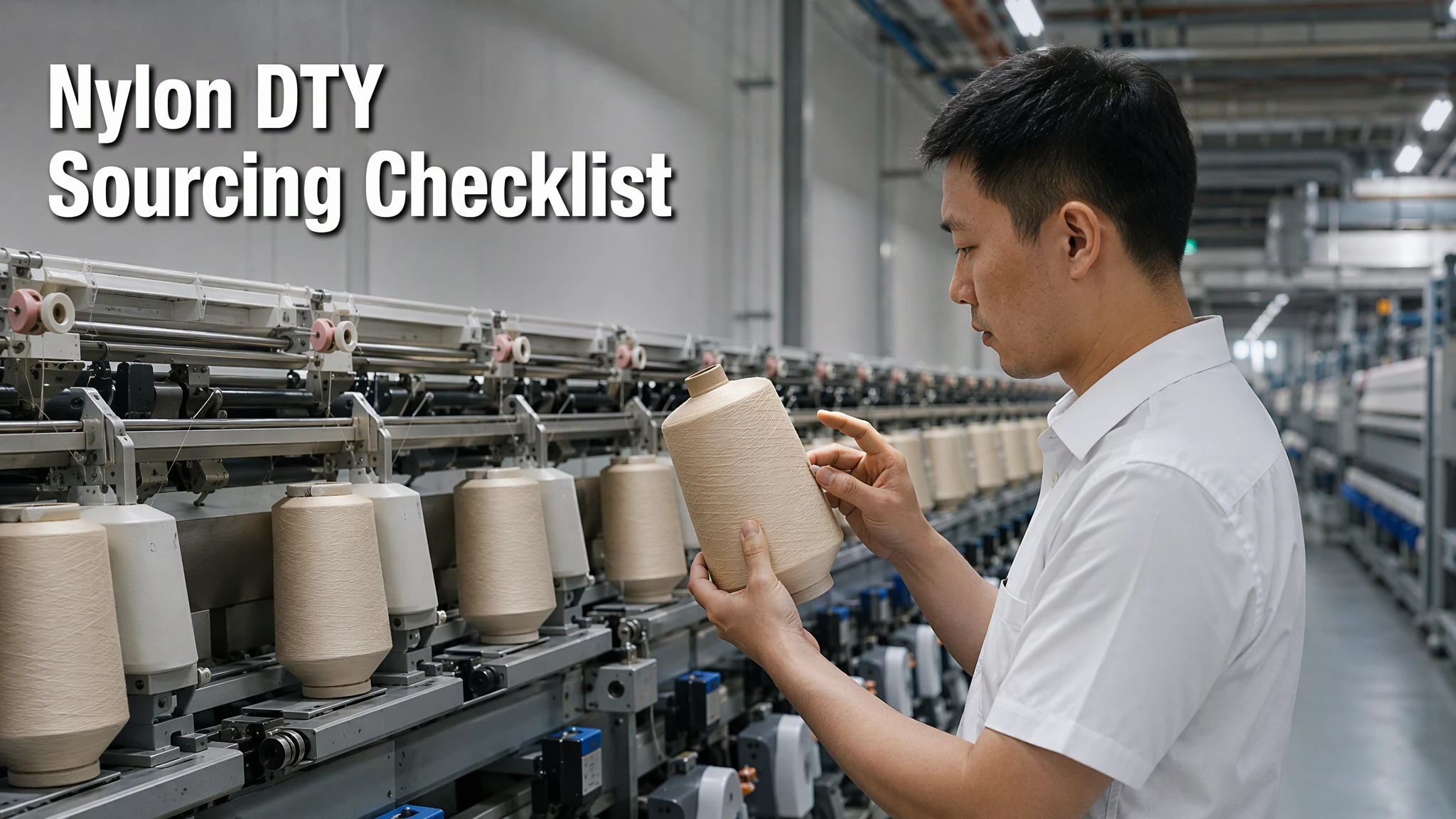
A practical Nylon DTY sourcing checklist covering denier, filament count, luster, color route, twist, intermingling, package format and sample approval.
Nylon DTY Sourcing Checklist: What Buyers Should Confirm Before Bulk Orders
Nylon DTY sourcing is rarely decided by denier alone. Two quotations may carry a similar headline count but differ in filament configuration, luster, color route, intermingling, twist direction or package format. Those details affect how the yarn runs and how the finished fabric looks. The practical way to compare offers is to build one written specification, test the same construction in sample form and approve the resulting fabric before releasing a bulk order.
SALUD's current product records list Nylon DTY across multiple denier/filament combinations and luster options. The range is broad enough that a buyer should not ask only for “nylon DTY” and expect an interchangeable result. This checklist turns an initial inquiry into a specification both sides can verify.
Start Nylon DTY sourcing with the end use
Begin with the textile, not the catalogue. A sock, seamless garment, knitted shoe upper and elastic webbing can place different demands on appearance, stretch recovery, coverage and machine behavior. Tell the supplier the machine type, intended construction, target fabric weight or density, finishing route and whether the approved reference is a yarn, a knitted swatch or a finished article.
SALUD's nylon yarn range provides a useful starting point, while its nylon and polyester filament product list separates the available product families. Neither replaces a buyer-specific specification.

A disciplined inquiry can be short:
- end use and machine/process;
- required denier and filament count;
- nylon grade or material basis to be confirmed;
- raw white, dyed or other agreed color route;
- luster, twist/intermingle and package requirements;
- reference color, yarn or fabric;
- sample quantity and evaluation method.
Lock the count and filament configuration
The internal SALUD product list records many Nylon DTY combinations rather than one universal construction. Examples in the Nylon DTY sheet include 10D/5F, 10D/12F, 15D/7F, 20D/24F, 30D/24F, 40D/34F, 70D/24F, 70D/48F, 70D/68F, 70D/96F, 100D/36F, 100D/48F, 100D/96F, 140D/48F, 140D/96F, 140D/136F and 280D/96F. Availability and the final construction still need written confirmation for the specific order.
Denier describes linear density; the filament count tells you how that total is divided. That is why changing only the “F” value can change coverage and surface character even when the “D” value remains familiar. SALUD has already published a focused comparison of 70D/24F/1 and 70D/48F/2 Nylon 6 DTY. Use such comparisons as a discussion aid, then verify the exact construction in your own knitting or weaving trial.

For the purchase specification, keep these fields separate:

Define luster, color route and approval standard
The SALUD Nylon DTY product list marks SD, BR and FD against numerous constructions. Treat those letters as specification fields—not as a complete visual approval. Ask both sides to write out the intended luster and compare a physical sample under agreed lighting.
Color route also belongs in the specification. SALUD's existing guide to dope-dyed and hank-dyed Nylon DTY explains that the route itself is a sourcing decision. A buyer should additionally define the color reference, viewing conditions, approval sample and whether the final judgment is made on yarn or fabric.

Do not approve a bulk color from a screen image alone. Monitor settings, lighting and photography can shift appearance. A physical yarn sample is better; a knitted or woven lab dip made in the intended construction is better still. Keep the approved piece, its identification and the written specification together.
Confirm intermingling, twist and package format
SALUD's detailed Nylon DTY sheet groups its published product families by raw white, twisted, dyed and intermingled forms. For twisted constructions, it records S or Z direction; for intermingled items, the website tables use intermingling as a separate field. That distinction matters at inquiry stage: twist and intermingling are not interchangeable words.
Ask the supplier to state what is included in the offered construction. If twist is required, specify direction and agreed TPM. If intermingling is required, state the agreed requirement and test method. If neither has been established, do not copy a number from another product into the order.
Package details deserve the same care. Confirm tube type, package dimensions, net weight, winding build, labeling and pallet/carton requirements. Package geometry must suit the buyer's creel and handling method; a correct yarn on an unsuitable package can still disrupt production.

Run a sample-to-bulk approval sequence
A practical sequence is:

Record the trial settings and compare like with like. If the buyer changes machine tension, stitch density, heat setting, dyeing route or finishing between samples, the evaluation no longer isolates the yarn. For technical questions, SALUD also provides a technical support contact.
A purchase-order checklist buyers can copy
Before issuing the order, confirm:
- product name and material basis;
- denier, filament count and ply;
- raw white/dyed status and color reference;
- luster definition;
- twist TPM and direction, when applicable;
- intermingling requirement and method, when applicable;
- package/tube dimensions, winding and net weight;
- approved yarn and fabric reference IDs;
- labeling, packing and document requirements;
- pre-shipment sample or inspection arrangement;
- procedure for approving any substitution or deviation.
The safest sourcing decision is not the specification with the most numbers. It is the one in which every number has a defined meaning, an agreed method and a physical reference where appearance matters.
Planning a Nylon DTY order? Send SALUD your end use, machine type, target denier/filament construction, luster, color route and reference sample through the contact page. Request a yarn sample and trial fabric confirmation before bulk approval; final supply should follow the mutually confirmed specification.
